Three jobs are waiting for the CNC. Two guys are standing around because materials haven't arrived. The spray booth is backed up for two days. And the job that was supposed to ship Friday is now looking like next Wednesday.
Every workshop owner knows the feeling. Bottlenecks are a fact of life in manufacturing — but most workshops are still managing them with whiteboards, spreadsheets, and the production manager's memory. That works at five jobs. It falls apart at fifteen.
Why whiteboards and spreadsheets don't cut it
Walk into most NZ manufacturing workshops and you'll find some version of the same system: a whiteboard on the wall, maybe a spreadsheet on someone's computer, and a lot of information living in the production manager's head.
- No real-time updates. The whiteboard shows the plan as of Monday morning. By Tuesday afternoon, three things have changed and nobody's updated it. The plan is fiction.
- Can't see capacity. You know Dave's busy. But how busy? 80% or 120%? Can he take a small job this week? Without data, you're guessing.
- No early warning system. A job running over budget doesn't trigger any alarm. You find out when it's done — too late to do anything about it.
- Dependencies are invisible. Job B can't start until parts from Job A are done. But that lives in someone's head. When Job A runs late, nobody adjusts Job B until it's a crisis.
- It doesn't scale. More people, more jobs, more machines, and the whiteboard breaks down exponentially.
The five most common workshop bottlenecks
Before you can fix bottlenecks, you need to name them. Here are the ones we see most often in NZ manufacturing workshops.
1. Machine bottlenecks
One machine — usually the most expensive one — becomes the choke point. The CNC, the press brake, the spray booth — whatever it is, everything queues up behind it. The issue isn't always capacity; sometimes it's scheduling. Two jobs both need the CNC on Wednesday and nobody planned around it. One waits. Everything downstream from it waits too.
2. Skill bottlenecks
Only one person can do a particular task. When they're sick, on holiday, or already flat out, that work stops. Common in specialised shops — your best welder, your most experienced cabinetmaker, your only programmer.
3. Material bottlenecks
The job is ready to start. The drawings are done. The team is available. But the aluminium extrusions won't arrive until next week. Material delays cascade through the schedule. Without visibility on what's coming when, you can't plan around them.
4. Information bottlenecks
Drawings aren't finalised. The client hasn't confirmed the spec. The production manager hasn't communicated yesterday's change. Work stops — or worse, it continues based on wrong information.
5. Handoff bottlenecks
The transition from one stage to the next is where jobs stall. CNC is done but parts sit on a rack for two days before assembly picks them up. In a shop with five or six stages per job, that's five or six chances for work to stall.
How scheduling software fixes this
Good workshop scheduling software doesn't just show you a pretty Gantt chart. It gives you a decision-making framework for allocating your most constrained resources: people, machines, and time.
Capacity planning
See each person's and each machine's workload across the week. Actual scheduled hours, not guesses. When you can see the CNC is at 95% capacity next week and the bench is at 60%, you can make smart decisions about what to schedule and when.
Dependency management
Define which tasks depend on which. If Assembly can't start until Machining is done, the software knows that. When Machining runs a day late, Assembly's start date shifts automatically. Everyone sees the updated timeline without anyone having to manually adjust it.
Real-time tracking against schedule
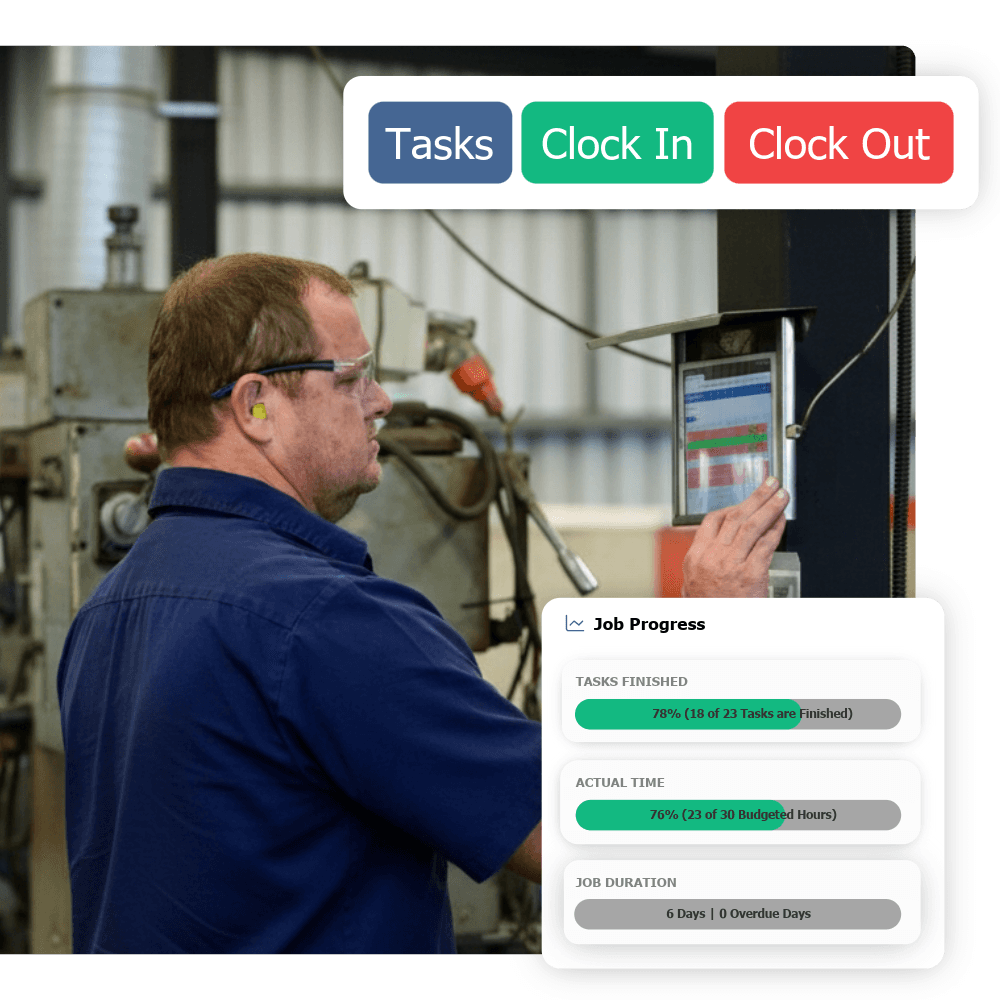
This is where scheduling and time tracking work together. Your schedule says this job should take 16 hours. Time tracking shows it's at 14 hours and 60% complete. Is it on track or running over? You can see the answer in real time, not at the end of the week.
Visual scheduling
Drag and drop jobs across resources. See conflicts highlighted. Spot gaps where you could fit a small job. This is where software beats a whiteboard — it shows the full picture across all resources, all jobs, all time periods at once.
The financial impact of better scheduling
Bottlenecks don't just cause delays. They cost real money.
- Overtime. When jobs run late, the fix is usually overtime — time-and-a-half or double-time, the most expensive hours of the week.
- Idle time. When one team waits for another, they're on the clock but not producing. Even 30 minutes per person per day adds up to over $45,000 per year in a 10-person shop.
- Expediting costs. Rush freight to get materials there faster. Rush the job through finishing. Band-aid fixes all have a price tag.
- Client penalties. Late delivery means unhappy clients. Sometimes it means contractual penalties. Always it means a harder conversation next time you quote.
- Lost opportunity. While you're firefighting delays on current jobs, you're not taking on new work.
$100k–$300k
Throughput recovered on a $2M shop moving from reactive to proactive scheduling
Getting scheduling right
Start with your constraints
Identify your bottleneck resources. What's the machine, person, or process that everything queues behind? Schedule your constraint first, then schedule everything else around it.
Measure before you change
Before you rearrange your schedule, track where time actually goes for 2–4 weeks. You need a baseline to know if your changes are working.
Build in buffer
No schedule survives contact with reality. Build 10–15% buffer in — not as slack, but as insurance against the inevitable surprises. Rush jobs, rework, material delays, sick days. They will happen.
Make the schedule visible
Everyone in the shop should be able to see the schedule — not just the production manager. When people can see what's coming next, handoffs get smoother and nobody's caught off guard.
Review weekly
Spend 15 minutes every Monday reviewing the week's schedule as a team. What's tight? Where are the risks? This simple habit prevents more crises than any software feature.
The bottom line
Bottlenecks are predictable. They happen in the same places, for the same reasons, week after week. The difference between a shop that's always firefighting and one that runs smoothly is data and planning.
Your margins depend on throughput. Your throughput depends on flow. And flow depends on scheduling. Get this right and the rest of your workshop runs better.