You're using Xero. Most NZ businesses are. It handles your invoicing, payroll, GST returns — the financial backbone of your operation.
But Xero wasn't built to tell you whether Job #4872 made money or lost it. It doesn't know that the kitchen install you quoted at 30 hours actually took 42. It can't show you that your spray booth is the reason three jobs ran over budget last month.
That's the gap job costing software fills. And if it doesn't integrate with Xero, you're going to end up double-handling data — which defeats the entire purpose.
Why Xero alone isn't enough for job costing
Xero is accounting software. It tracks money in and money out. It can do basic tracking codes and projects, but it's not designed for the kind of granular, real-time job costing that manufacturers need.
- Real-time labour tracking against jobs. Xero knows what you paid someone this week. It doesn't know they spent 6 hours on Job A, 12 hours on Job B, and 2 hours on rework for Job C.
- Material allocation per job. You bought $3,000 of timber this month. How much went to each job? Xero sees the purchase, not the allocation.
- Work in progress (WIP) visibility. How much labour and materials have gone into the job sitting half-finished on the workshop floor? Xero can't tell you. Dedicated job costing software can.
- Variance analysis. You quoted 20 hours. It took 28. Where did the extra 8 hours go? You need time tracking data linked to job data to answer that question.
What good integration actually looks like
"Integrates with Xero" gets thrown around a lot. But the quality of integration varies wildly. Here's what you should expect from a proper integration:
Timesheet data flows automatically
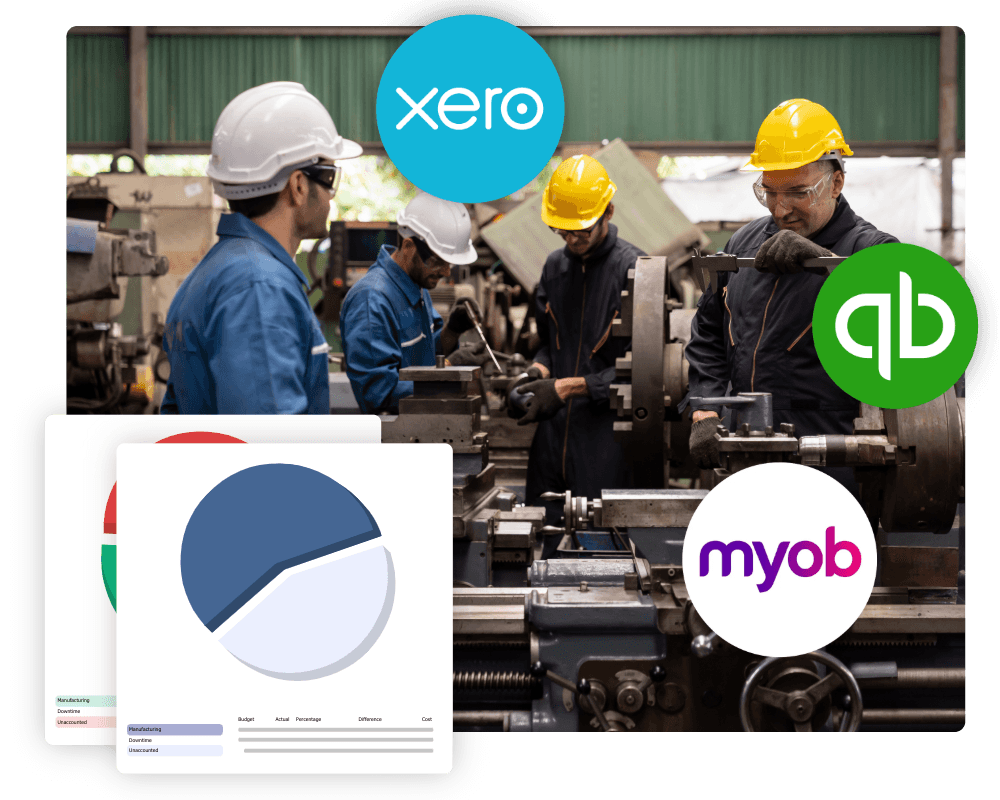
Your team logs time against jobs in the workshop software. At the end of the pay period, that data flows straight into Xero for payroll processing. No re-keying. No CSV exports. No manual matching.
This saves hours of admin time every week. More importantly, it eliminates the errors that come with manual data entry. One wrong decimal point in a timesheet and your payroll is wrong, your job costs are wrong, and your GST return might be wrong too.
Job costs match your accounts
The labour costs tracked in your job costing software should reconcile with what's in Xero. When you look at a job in your workshop software, the numbers should match what your accountant sees. If they don't, you've got two sets of books — and that's a headache nobody needs.
Invoicing is informed by actual costs
Some integrated systems let you generate invoices based on actual tracked time and materials. Quoted 30 hours at $85 and the actual was 36? You see that before the invoice goes out. Whether you bill the extra or absorb it is your call — but at least you're making an informed decision.
What NZ manufacturers specifically need
Generic job costing software exists. Plenty of it. But manufacturing workshops have specific requirements that general-purpose tools don't handle well.
Shop floor time tracking
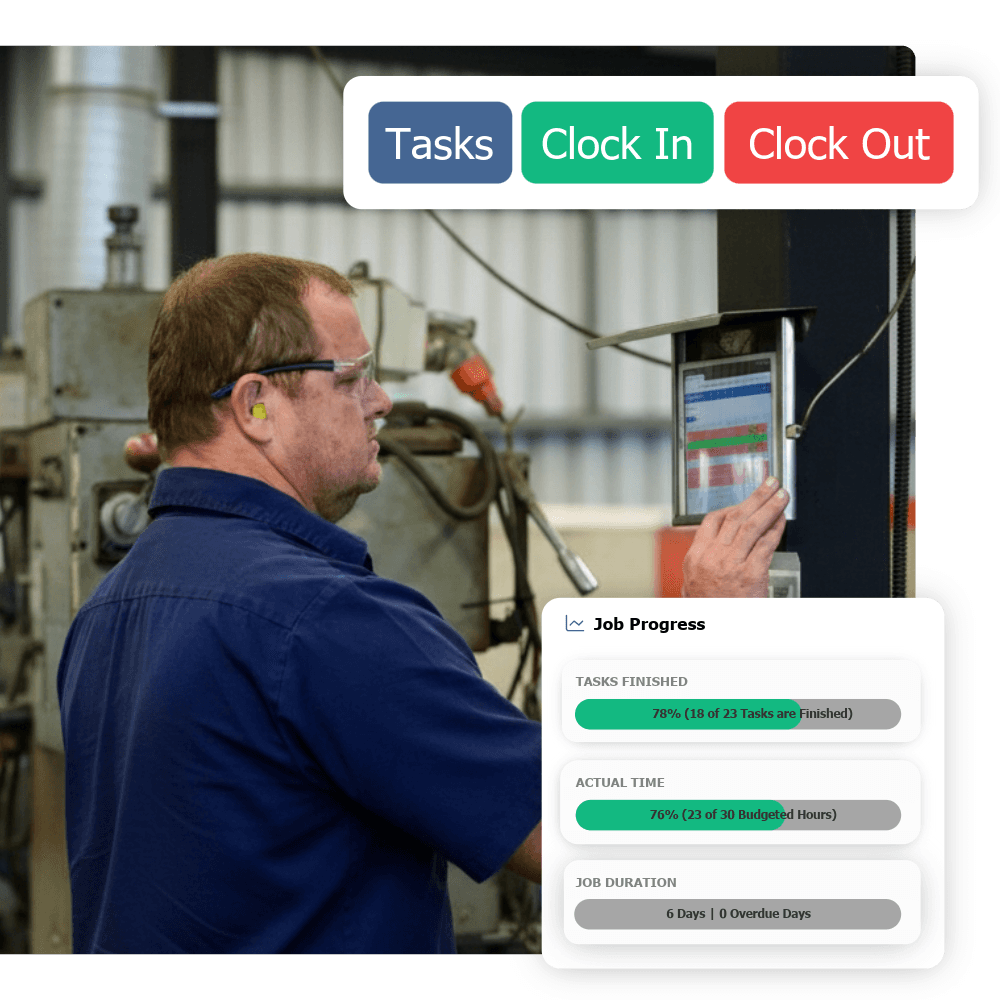
Office-based time tracking (log in to a web app, type your hours) doesn't work on a workshop floor. Your team has dirty hands, limited computer access, and better things to do than fight with software.
You need kiosk-based entry — touchscreens, barcode scanners, or tablet stations near the work area. Clock on to a job with a tap. Clock off with a tap. Anything more complicated and adoption drops to zero.
Job-based scheduling
Knowing what a job cost is useful. Knowing what it should have cost is more useful. And planning what it will cost is most useful of all. When scheduling and time tracking live together, you get real-time variance data — you can see a job running over budget while there's still time to do something about it.
NZ compliance built in
Holiday pay calculations, ACC levies, public holidays, minimum wage rules — these are all specific to New Zealand. If your software makes you configure these manually, you'll get them wrong. If it handles them natively, that's one less thing to worry about.
The real cost of getting this wrong
Workshop owners often tell us they "sort of" track job costs. They have a rough idea. They know which jobs feel profitable and which ones don't. But feelings aren't data. And in a tight-margin business, the gap between "roughly right" and "accurately measured" can be the difference between a profitable year and a break-even one.
How to evaluate your options
- Xero integration depth. Does it just export a CSV, or truly sync data? Can payroll timesheets flow automatically?
- Shop floor usability. Try logging a time entry yourself. If it takes more than two taps, your team won't use it consistently.
- Implementation timeline. For a typical workshop you should be up and running in one to two weeks. Months means the software isn't well-suited to your industry.
- NZ support. When something goes wrong — and it will — can you talk to someone in your timezone who understands NZ payroll and tax rules?
- Reporting. Can you pull a job profitability report in under 30 seconds? Can you see WIP across all active jobs? If the reporting takes work to get to, you won't use it.
Making the switch
If you're currently running Xero without proper job costing, the transition doesn't have to be painful:
- 1Week 1: Set up the software, configure your job stages and cost categories, import your current jobs, connect the Xero integration.
- 2Week 2: Train your team on shop floor time tracking. Start logging time against live jobs. Run payroll through the integrated system.
- 3Weeks 3–4: Pull your first reports. Compare actual costs against your quotes. Identify your biggest variance jobs. Adjust your quoting templates.
- 4Month 2 onwards: You now have a month of real data. Your quotes are getting more accurate. Your job profitability reports are showing you where to focus.
The bottom line
Xero handles your accounting. But for NZ manufacturers, you need a layer on top that tracks labour, materials, and time at the job level — and feeds that data back into Xero automatically.
Look for tight Xero integration, shop-floor-friendly time tracking, and NZ-specific compliance. Get those three things right and the rest follows.